At five years old, children are curious about the world around them. They enjoy experimenting with colors, making shapes, drawing familiar objects, and turning simple ideas into pictures. An art class gives them a place to explore these interests while developing skills that support their early learning.
At this age, art education should focus on exploration rather than creating perfect drawings or paintings. Children benefit most when they can experiment with different materials, express their thoughts, and enjoy the process of making something of their own.
So, what should a 5-year-old learn in an art class? From basic drawing skills to color recognition and creative thinking, there are several useful foundations that young children can develop through age-appropriate art activities.
1. Recognizing Colors, Shapes, and Patterns
Learning about colors and shapes is a natural starting point for young artists. Children can explore primary and secondary colors, identify basic shapes, and notice how different forms fit together to create a picture.
Simple activities, such as painting a colorful garden or drawing a house using squares, rectangles, and triangles, help children connect basic concepts with practical experience.
Art instructors can also introduce simple patterns, such as alternating colors or repeating shapes. These exercises encourage observation and help children understand how individual elements work together in an artwork.
2. Developing Basic Drawing Skills
Five-year-olds are still developing hand control and coordination, so drawing activities should be simple, enjoyable, and flexible. Children can practice making straight lines, curved lines, circles, and other basic marks before using them to draw familiar subjects.
For example, a few circles and lines can become a smiling face, while simple shapes can form a cat, tree, or butterfly. These activities help children understand that pictures can be created by combining basic elements.
Well-planned art classes for kids introduce these skills gradually without expecting every child to progress at the same pace. The aim is to build confidence and encourage children to keep experimenting with their ideas.
3. Exploring Painting and Different Art Materials
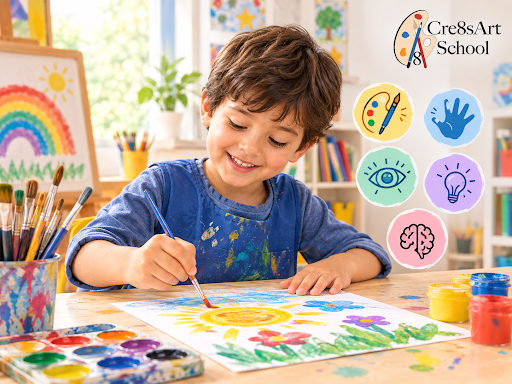
Painting gives children an opportunity to experiment with color, texture, and movement. They can learn how to use brushes, sponges, crayons, washable markers, and child-friendly modeling materials under appropriate supervision.
Activities such as finger painting, watercolor experiments, and paper collage allow children to discover how different materials create different effects.
In suitable art and painting classes, children can also learn simple habits, such as rinsing brushes, using materials carefully, and cleaning their workspaces after an activity. These small routines encourage independence while keeping art sessions organized and enjoyable.
4. Encouraging Creativity and Imagination
One of the most valuable lessons for a five-year-old is learning that there is more than one way to create a picture. A child might paint a purple tree, draw a flying elephant, or invent a character that does not exist in real life. These ideas provide opportunities for imagination and self-expression.
Rather than correcting every unusual choice, instructors can ask open-ended questions such as, “What is happening in your picture?” or “What inspired you to use those colors?”
This approach allows children to explain their ideas and make creative decisions. It also helps them understand that their artwork does not need to look exactly like someone else’s to be meaningful.
5. Improving Hand-Eye Coordination and Fine Motor Skills
Holding a paintbrush, controlling a crayon, tearing paper, and pressing modeling clay all involve small hand movements. These activities give children opportunities to practice coordination and control.
Such experiences can support the development of skills used in everyday activities, including drawing, using classroom tools, and beginning to write.
At this age, children do not need complicated projects. Simple activities that involve tracing large shapes, painting broad strokes, or arranging paper pieces can provide plenty of practice.
6. Learning to Follow Instructions and Work Independently
Art classes can also introduce children to simple routines. They might learn to select materials, listen to a short demonstration, complete a few steps, and put supplies away afterward.
Group projects provide opportunities to share materials, take turns, and appreciate what other children create. At the same time, individual projects allow children to make their own decisions.
When exploring art classes for kids in Hawthorne, parents can look for programs that balance teacher guidance with independent creativity. A welcoming environment helps children participate without feeling pressured to produce perfect results.
How Can Parents Choose the Right Art Class?
Look for a class designed for your child’s age, attention span, and interests. Lessons should include hands-on activities, safe materials, manageable instructions, and room for experimentation.
Although art classes for adults and online art courses can offer valuable learning opportunities for older students, a five-year-old generally benefits from activities specifically designed for early childhood. Parents should check whether an online program includes age-appropriate demonstrations and suitable supervision.
The best learning experience is one where children feel comfortable asking questions, trying new materials, and sharing their ideas.
Give Your Child Room to Create
A five-year-old does not need to master advanced drawing techniques to benefit from art education. Learning colors, exploring shapes, practicing brush control, and expressing original ideas are meaningful starting points.
Cre8sArt offers families an opportunity to explore creative learning and discover ways to nurture artistic interests. Visit the Cre8sArt website to learn more about art education and help your child begin a creative journey.
FAQs
1. What should a five-year-old learn in an art class?
Children can explore basic colors, shapes, lines, painting, drawing, and simple crafts. Classes should also encourage imagination, self-expression, and experimentation.
2. Are art classes beneficial for five-year-old children?
Yes. Age-appropriate art activities provide opportunities to practice fine motor skills, hand-eye coordination, observation, communication, and creative problem-solving.
3. How long should an art class be for a five-year-old?
The ideal duration depends on the child’s interests and attention span. Short, varied activities with breaks or transitions can help keep young children engaged.
4. What art supplies are suitable for five-year-olds?
Washable paints, chunky crayons, child-friendly brushes, large sheets of paper, modeling clay, and pre-cut collage materials are useful options. Choose age-appropriate, non-toxic supplies.
5. How can I find art classes for kids in Hawthorne?
Look for classes that offer age-appropriate instruction, hands-on painting and drawing, small-group activities, and opportunities for creative exploration. Ask about class structure and instructor experience before enrolling.