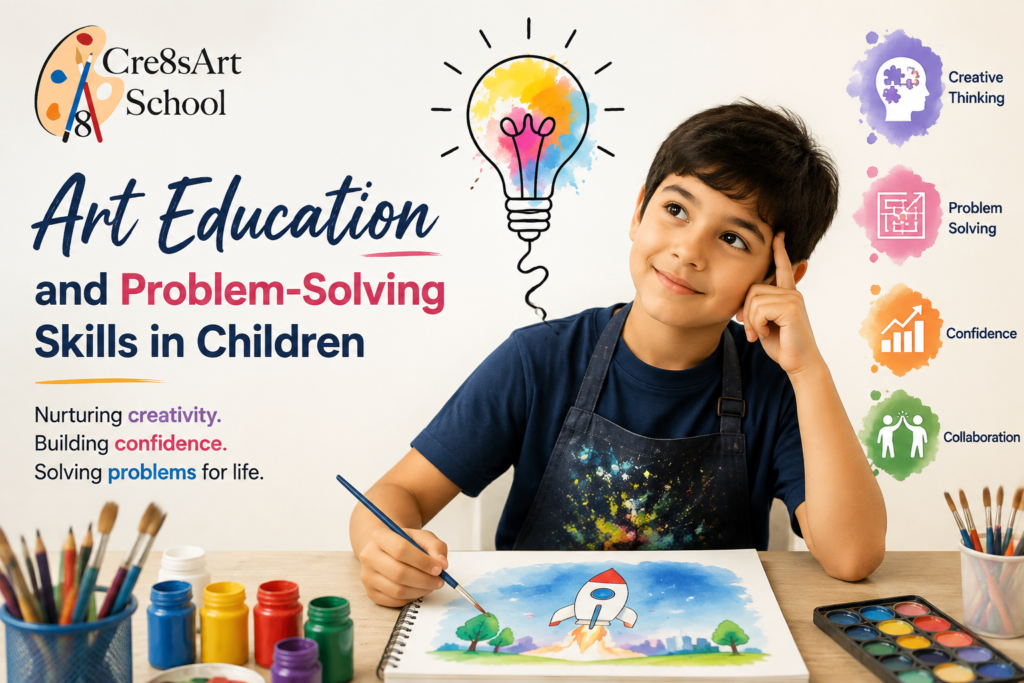
When your child picks up a paintbrush or shapes clay with their hands, something powerful is happening; they’re not just creating something beautiful, they’re building real, meaningful problem-solving skills. At cre8sart, we’ve seen firsthand how art education transforms the way children think, approach challenges, and believe in their own abilities.
Every stroke of color, every creative choice, every “happy accident” is teaching your child something invaluable: how to think through problems, adapt their approach, and trust their instincts. That’s the heart of what we do.
Why Art Education Matters for Problem-Solving
Here’s what makes art education so powerful: unlike many other activities, art problems don’t have a single “right” answer. When your child decides which color to blend, how to handle a brushstroke that didn’t go as planned, or whether to reimagine their entire approach, they’re engaged in real problem-solving.
This experience teaches flexibility and creative thinking in ways that traditional learning often doesn’t. Your child learns that challenges are opportunities not roadblocks. When they face a painting problem in class, they’re building the exact same thinking skills they’ll need to handle math problems, writing challenges, and real-world obstacles.
What researchers consistently find is clear: children who engage in art education develop stronger critical thinking abilities. They become more flexible thinkers. They learn to see multiple solutions where others see only one path forward.
Building Confidence Through Creative Challenges
At cre8sart, we know that not every art project goes smoothly. Paint drips. Colors don’t mix the way they imagined. Brushstrokes go off the line. The clay doesn’t hold its shape.
And that’s exactly where the real learning happens.
When your child learns to troubleshoot in art class, adjusting their technique, trying a new approach, accepting a “mistake” as part of the creative process they’re building genuine resilience. They’re learning that effort and iteration lead to improvement. That persistence matters. That they can figure things out.
This confidence in their own problem-solving ability carries into every other area of their life. When they approach a difficult math problem, a challenging reading assignment, or a social situation, they carry that art-class lesson with them: “I can work through this. I can try a different approach. I can improve.”
Developing Visual-Spatial Skills and Creative Thinking
Creating art demands something unique from your child’s brain: they have to imagine something in their mind and then translate it to physical form. They work with space, proportion, perspective, and balance. They make countless tiny decisions about light, shadow, color, and composition.
These aren’t just art skills. These are the same visual-spatial reasoning abilities that support success in mathematics, science, reading, and engineering. When your child understands how to work with proportion and perspective, they’re building brain skills that reach far beyond the canvas.
Our digital painting classes in Hoboken introduce your child to spatial reasoning using modern digital tools they still develop the same powerful cognitive skills, just in a new medium. Whether your child is working with traditional paint or digital brushes in art and painting classes in Hoboken, they’re building these critical visual-thinking abilities.
Learning Together: Collaboration and Communication
Some of the most important moments in art classes for kids in Hoboken happen when children work on group projects. When your child collaborates on a mural, a shared sculpture, or a group creative challenge, something special occurs: they learn to listen, share ideas, respect different perspectives, and negotiate solutions.
These are real-world problem-solving skills. Your child learns that other people’s ideas can make their own work stronger. They discover that their unique perspective has value. They practice communicating their thoughts clearly and listening deeply to others.
At cre8sart, we believe that this collaborative learning is just as important as individual skill development. When children create together, they’re building the exact communication and teamwork abilities that will serve them throughout their academic and professional lives.
Strength in the Details: Fine Motor Development
Building problem-solving ability isn’t just a mental exercise, it’s physical, too. When your child holds a brush with precision, blends colors smoothly, or carefully shapes clay, they’re developing fine motor control. They’re practicing patience, attention to detail, and sustained focus.
Here’s something amazing: as these physical skills improve through practice, so does the child’s patience with themselves in all learning situations. They understand that small improvements compound. They experience firsthand that practice and repetition lead to growth. That mindset transforms how they approach every challenge, artistic and otherwise.
How cre8sart Supports Your Child’s Development
Since 2012, cre8sart has been dedicated to helping children discover and develop their creative voices while building confidence, discipline, and real-world problem-solving ability. Our curriculum goes beyond basic art instruction. We’ve built something special: a community where children of all ages and skill levels feel encouraged to explore, experiment, and grow.
Our instructors aren’t just artists, they’re educators who understand how children learn. They guide each student through projects that encourage experimentation and creative decision-making, rather than demanding “correct” outcomes. We celebrate the process just as much as the finished piece.
Whether your child is exploring art and painting classes in Hoboken, joining one of our other New Jersey locations, or diving into our digital painting classes in Hoboken, they’re joining a community that truly understands the power of creative learning. We conduct twice-yearly skill assessments so you can see clear progress. We provide weekly updates on current projects and learning goals. And most importantly, we create a safe, encouraging space where every child feels free to take creative risks and learn from them.
Key Benefits Your Child Will Gain
Flexible Thinking: Art teaches that multiple solutions exist for one problem. That flexibility becomes automatic in all learning.
Resilience and Adaptability: Your child learns to pivot when something doesn’t work. They learn that setbacks are part of growth.
Confidence in Problem-Solving: Completing art projects gives children tangible proof that they can work through challenges independently.
Attention to Detail: Art demands precision and observation. These skills strengthen across all academic subjects.
Self-Expression: In a world where your child often feels the pressure to give “right” answers, art offers freedom to communicate their unique thoughts and feelings.
Collaboration Skills: Working with peers teaches your child that other perspectives strengthen solutions.
Final Thoughts
Art education is so much more than a creative outlet or a way to keep your child busy. It’s a powerful way to develop the problem-solving abilities, resilience, and confidence that can serve children throughout their lives. When your child learns to think flexibly, embrace challenges, and find solutions through art, those skills become part of how they approach everything.
At Cre8sArt, we’ve been on this journey with thousands of students from ages 3 to 90. We’ve watched shy children find their voice, struggling students discover confidence, and young artists realize, “I can figure this out. I can create something meaningful. I can solve problems.”
If you’d like to help your child develop creativity, confidence, and problem-solving skills through art , Contact Us to learn more about our programs and find the right creative learning opportunity for them.
FAQs
At what age can children start art education and begin building problem-solving skills?
Children benefit from art experiences starting around age 3, though even toddlers gain from open-ended creative play with brushes and paints.
How does art training in class actually improve academic performance?
Art develops spatial reasoning and visual thinking that directly supports math and science learning, plus it builds focus and persistence that helps with all subjects.
How often should my child attend art class to see real progress?
Weekly classes offer the best momentum and skill-building, though bi-weekly sessions still provide meaningful development and problem-solving practice.
Is traditional painting better than digital art for developing problem-solving skills?
Both build problem-solving equally well; digital art presents unique challenges and decision-making opportunities alongside traditional mediums.
What’s the difference between art classes and simply letting my child play with art supplies at home?
Structured instruction with guidance builds specific skills and confidence, while free play is wonderful for exploration ideally, children benefit from both.
How can I support my child’s learning at home?
Provide open-ended art materials, ask about their creative choices and thinking, and celebrate their effort and experimentation rather than just final results.