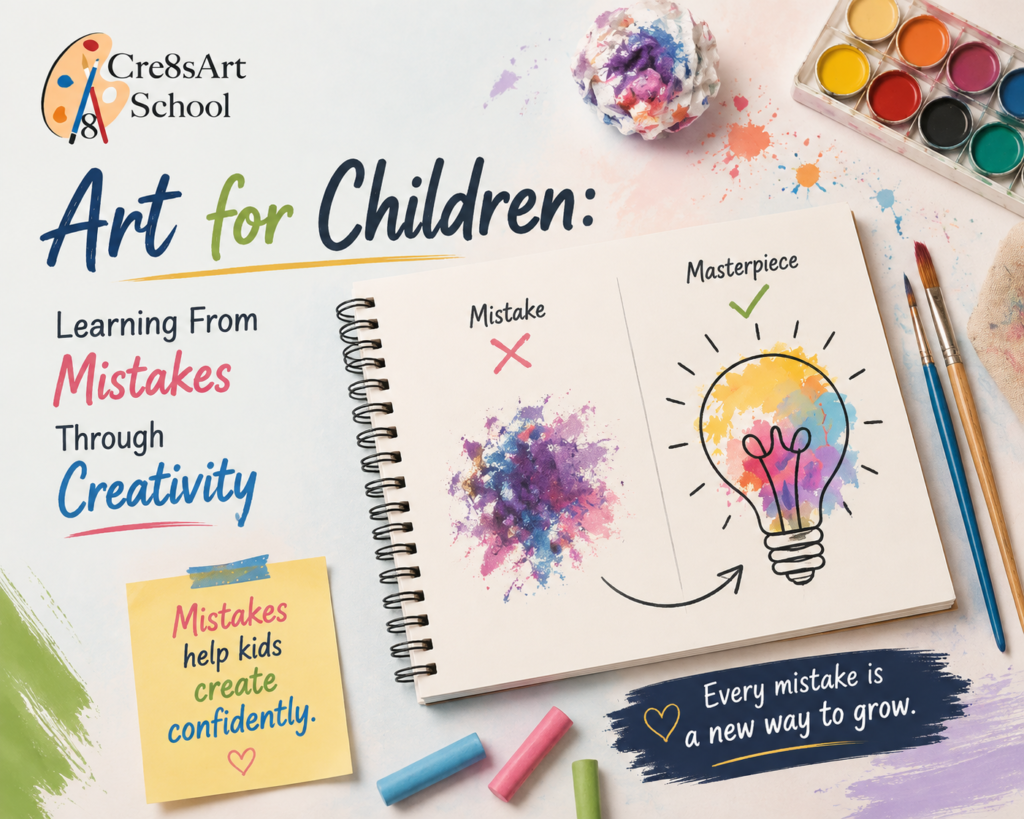
We’ve all been there watching a child crumple up their artwork because it didn’t turn out “perfect.” In that moment of frustration lies an incredible opportunity that many parents and educators miss. Art for children isn’t just about creating pretty pictures; it’s one of the most powerful tools we have to help young minds embrace mistakes and learn from them.
At cre8sart, we’ve spent years working with kids of all skill levels, and we’ve noticed something consistent: the children who thrive are those who understand that mistakes aren’t failures, they’re stepping stones. Art teaches this lesson better than almost anything else, and here’s why it matters so much.
Why Mistakes Matter in Art for Children
When a child picks up a paintbrush or sketches with a pencil, they’re taking a risk. That’s the beauty of it. Unlike multiple-choice tests where there’s one “right” answer, art for children offers countless possibilities. If the color runs outside the lines, it becomes an unexpected technique. If a brushstroke doesn’t match what they envisioned, it might create something even more interesting.
This is fundamentally different from how mistakes are treated in other areas of learning. In traditional academics, a mistake often means losing points or feeling embarrassed. But in art, mistakes are sometimes the most creative moments. A child might add layers to hide what they didn’t like, or they might step back and realize the “mistake” actually enhanced their work.
cre8sart classes are specifically designed around this principle. We encourage children to experiment freely, knowing that every “oops” is actually a learning opportunity disguised as a happy accident to borrow Bob Ross’s famous phrase.
Building Resilience Through Creative Expression
When children participate in art classes for kids in Fort Lee or online art classes in Fort Lee, they’re not just learning techniques. They’re building emotional resilience. Here’s the psychological side of what’s happening: each time a young artist works through a mistake and finds a solution, they’re strengthening their ability to handle challenges in life.
This process builds confidence. A child who has spent an afternoon reworking a painting, trying new colors, and adjusting their approach learns something invaluable: I can figure things out. I don’t have to get it right the first time. Problems don’t have to stop me.
That confidence? It transfers everywhere. To school. To friendships. To trying new things. When art for children becomes a safe place to fail and learn, children become braver in all areas of their lives.
The Growth Mindset Connection
Psychologist Carol Dweck’s research on growth mindset shows that people who believe their abilities can be developed through dedication perform better and are more resilient. Art is one of the best environments to cultivate this mindset because the feedback is instant and visible.
A child can see their work, identify what they want to change, and immediately try a different approach. In our cre8sart studio, we see this happen every day. A student tries blending colors and it creates mud. Instead of giving up, they try a different color combination. They’re not just learning color theory, they’re learning that effort and persistence lead to improvement.
This is exactly the kind of thinking that helps children tackle homework challenges, navigate social situations, and develop into curious, adaptable learners.
How Mistakes Become Learning Gold
So what does this actually look like in practice? When working with art for children at our studio, here are the most common “mistakes” we see transform into learning moments:
Mixing colors into brown or gray: Instead of seeing this as a loss, we talk about how every color has a warm and cool version, and how neutrals have their own beauty. The child learns actual color theory through discovery.
Uneven proportions: This becomes a conversation about how artists sometimes exaggerate proportions intentionally for emphasis or style. Suddenly the “mistake” becomes an artistic choice.
Changed their mind mid-project: We celebrate this! It teaches problem-solving and flexibility. Maybe they paint over part of it, use it as a background element, or start fresh knowing more about what they like.
These moments might seem small, but they’re where learning happens.
Art for Children in Your Community
Whether you’re considering art classes for kids in Fort Lee for your child, exploring online art classes in Fort Lee, or even looking for adult art classes in Fort Lee for yourself, the principle remains the same: art is a judgment-free zone where experimentation is encouraged.
cre8sart has built our entire philosophy on this foundation. We know that children need a space where mistakes don’t come with grades or criticism, they come with curiosity and the chance to try again. That’s where real learning begins.
Why This Matters Beyond the Classroom
Parents often ask us: “But will my child actually improve at art?” Yes, absolutely. But more importantly, your child will improve at learning itself. They’ll become more comfortable with uncertainty. They’ll develop problem-solving skills. They’ll learn to give themselves grace when things don’t work out perfectly the first time.
These are life skills that have no standardized test measures but that matter enormously. In a world that often feels like it demands perfection, art for children teaches an essential counterpoint: there’s beauty in the process, not just the product.
Final Thoughts
The next time your child gets frustrated with their artwork, remember that mistakes are part of learning. Art for children at Cre8sArt encourages kids to experiment, learn from mistakes, and try again without fearing imperfection.
These skills help build confidence, resilience, and curiosity that last beyond the classroom. Contact Us to learn more about our art programs for children.
FAQs
At what age can children start learning art and benefiting from these lessons?
Children as young as 3-4 years old can start with basic art experiences, but kids aged 5 and up benefit most from structured art classes where they can process mistakes thoughtfully.
Will my child get frustrated if their art doesn’t turn out the way they imagined?
Some frustration is normal and actually healthy; our teachers are trained to help children reframe these moments as learning opportunities rather than failures.
How is art for children different from free play?
While free play is wonderful, guided art classes teach specific techniques and intentional problem-solving strategies that help children develop deeper resilience and skill.
Are there art classes for kids in Fort Lee that specifically focus on this kind of learning?
Yes! cre8sart offers classes designed around growth mindset and creative problem-solving, both in-person and online options.
Can shy or anxious children benefit from art classes?
Absolutely art provides non-verbal expression and removes performance pressure, making it perfect for sensitive learners.
Do I need to have artistic talent to encourage my child in art?
Not at all! In fact, parents who show their own willingness to try and make mistakes model the exact mindset we want children to develop.